
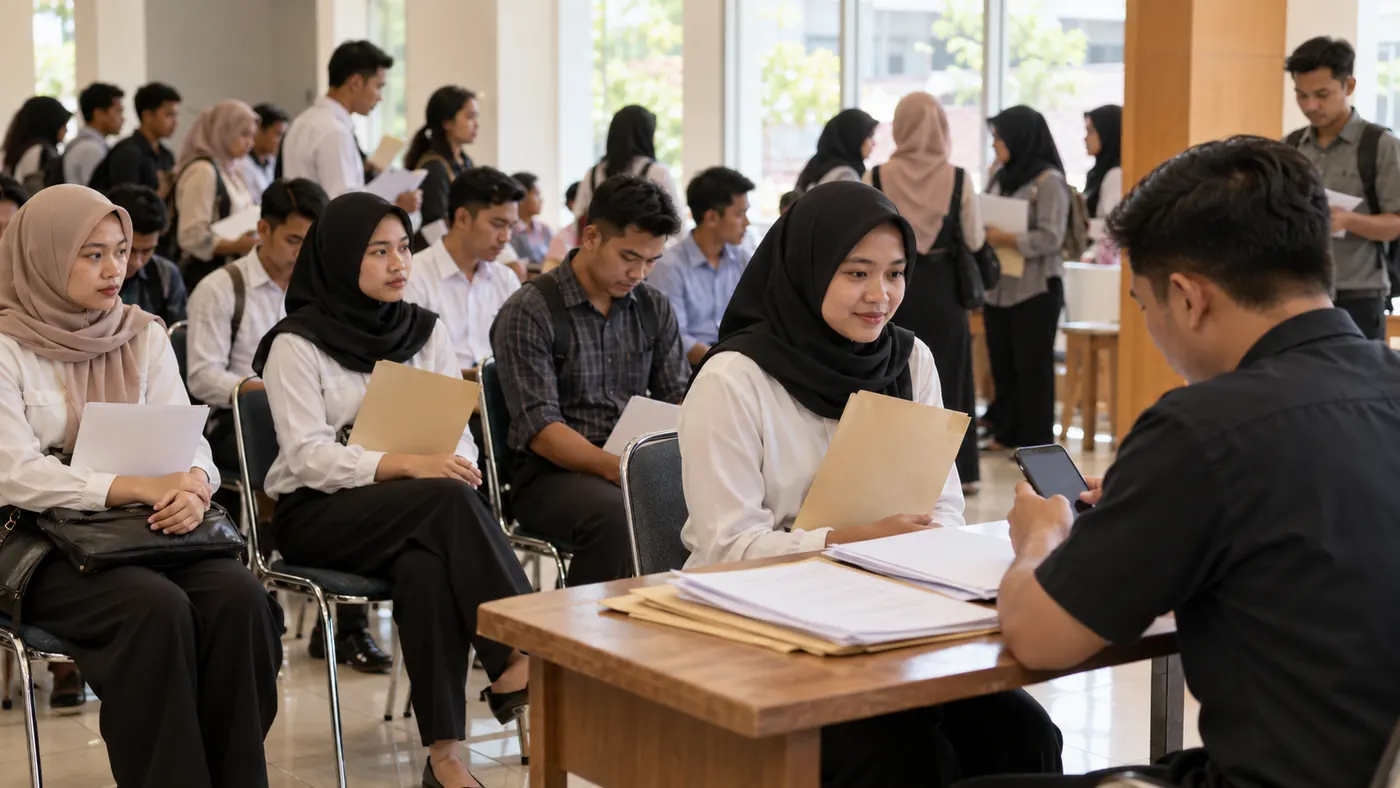
Ramadan seasonal hiring in Indonesia and Malaysia means recruiting dozens to hundreds of seasonal or permanent staff before the Ramadan and Eid al-Fitr shopping peak. For 2027, plan from mid-November 2026, aiming to have new hires trained before the first day of Ramadan, expected on 8 February 2027. To get there, you need clear criteria for each site, a short interview candidates can answer on their phones, and a quick reply to every applicant.
The pattern repeats every year. Area managers ask for extra cashiers and sales assistants across a dozen stores, the warehouse needs helpers for night shifts as online orders climb, and everyone needs them on the same date. The day the roles go live, HR's WhatsApp fills up. This plan works backward from the first day of Ramadan.
When are Ramadan and Eid 2027?
In Indonesia, BRIN's prediction using the MABIMS criteria puts 1 Ramadan 1448 H on 8 February 2027 and Eid al-Fitr (Idulfitri) on 10 March 2027. Under the KHGT calendar used by Muhammadiyah, 1 Syawal falls on 9 March 2027 (Metro TV, in Indonesian, 28 September 2026). The official dates are set by the government's isbat session.
In Malaysia, the 2027 public holiday list has Chinese New Year on 6 and 7 February and Hari Raya Aidilfitri on 10 and 11 March 2027, with the start of Ramadan expected on 8 February. The Keeper of the Rulers' Seal announces the final Ramadan and Raya dates after the moon sighting. A one-day shift in either country barely changes a hiring plan.
Two other dates matter. In Indonesia, the Christmas and New Year break eats the last two weeks of December: managers take leave, candidates go home, and interview schedules fall apart. In Malaysia, year-end leave and school holidays have a similar effect. In Malaysia, Chinese New Year lands two days before Ramadan, so retailers with a large Chinese customer base need festive staff on the floor by mid-January, and those staff can carry straight on into Ramadan.
Seasonal hiring timeline, counted back from 1 Ramadan
| When | Approximate date | What to do |
|---|---|---|
| 12 weeks before | Mid-November 2026 | Agree headcount per store or warehouse with area managers, and the must-have requirements per role. In Malaysia, start two weeks earlier. |
| 10 weeks before | Late November 2026 | Roles go live. Screening runs daily from the first application. |
| 7 weeks before | Around 18 to 21 December 2026 | First shortlist done before the Christmas break. |
| 4 weeks before | Mid-January 2027 | Manager interviews, offers, medical checks if needed, and contracts. |
| 2 weeks before | Late January 2027 | Training and onboarding. Keep a backup list for people who drop out. |
| After Eid | Mid-March 2027 | Second wave to replace staff who leave after the holiday. |
The dates assume 1 Ramadan on 8 February 2027. If your business only gets busy in the last week of Ramadan, for example a clothing store, shift everything one or two weeks later.
Why plan a second wave after Eid?
In Indonesia, the religious holiday allowance (THR) must be paid no later than seven days before the holiday (Minister of Manpower Regulation No. 6 of 2016). Some employees wait for their THR before resigning, so expect some departures after Eid (Lebaran). In Malaysia, the Employment Act 1955 does not require a festive bonus, but some new hires who go back to their hometowns for Raya do not return, and some only wanted work for the festive season.
A second wave is easier if you keep the candidates from the first. Applicants who passed screening but missed out on a slot in January are the first people to call in March. They have already been assessed, so you only need to check that they are still available.
How to screen hundreds of applicants per site
In mass hiring, a lot of time goes to applicants who turn out not to fit the location or shift, and you often only find out at the interview. This order moves those checks to the front:
- Create one pipeline per location. A store in Bekasi and a store in Shah Alam have different needs, and each area manager only needs to see candidates for their own stores.
- Put knockout questions first: where the applicant lives or how far they are from the site, willingness to work nights or weekends, start date, and requirements such as a motorcycle license for couriers. These answers are objective and can be checked automatically.
- Add a short interview candidates can answer on their phones. For cashiers or sales assistants, two or three questions are enough: customer service experience, how they handle a long queue, and their availability during Ramadan.
- Have store managers review the shortlist only. A store manager pulled off the floor for a full day of walk-in interviews is a cost that rarely gets counted.
Walk-in applicants do not need a separate track. Put up a QR code or link on site, ask applicants to fill it in on their own phones, and everyone ends up in the same flow.
Do not keep candidates waiting
Candidates for operational roles often apply to several employers at once. If it takes you a week to call back, the good ones may already have signed elsewhere. That is why screening has to run every day from the moment the role goes live.
A few habits that help:
- Send the screening invite as soon as an application arrives, by WhatsApp or email.
- Say up front how long the process takes and when you will reply.
- Tell unsuccessful applicants. A short, polite message saves them from waiting with no answer, and you can still contact them for the next wave.
Make sure your job ad does not look like a scam
Job scams, including over WhatsApp, are common. In Indonesia, data from the Indonesia Anti-Scam Centre, run by OJK, shows 18,220 reports of job offer fraud and Rp656 billion in losses between November 2024 and 15 October 2025 (Kompas TV, in Indonesian, 22 October 2025). Indonesia's Ministry of Manpower has also reminded job seekers that a credible recruiter never charges applicants a fee (Antara, in Indonesian, 13 January 2025).
For your own ads, that means:
- Show the company name and work location clearly in the ad and in WhatsApp messages.
- Send links from an official domain or account, and tell applicants how to verify the opening.
- State plainly that the hiring process is free, including uniforms and training.
- Do not ask for ID card photos or other sensitive documents at the first stage if you do not need them yet.
Seasonal hiring checklist before roles go live
- Headcount per site and per shift agreed with area managers
- Must-have requirements per role written down, and kept to a few
- Knockout questions and short interview questions ready
- Message templates for successful and unsuccessful applicants
- Dates for manager interviews, medical checks, and training locked in the calendar
- A plan for the second wave after Eid
Where Inhire fits
Inhire (inhireai.app) is an AI screening and AI interview platform for high-volume hiring. Inhire runs the first round described above: knockout questions, AI interviews by voice or text in a phone browser with no app to install, invites by WhatsApp or email, and automatic messages for applicants who do not make the shortlist. HR and store managers get scorecards with transcripts and decide for themselves who moves forward.
For a sense of the volume, PT TRIGANA ABADI SWAKARSA received more than 700 applicants for one job posted on Inhire. How to handle a pile like that is covered in the guide to screening 1,000 applicants, and the full workflow is on the AI screening for high-volume hiring page.
If you have started preparing for Ramadan hiring, try the flow at one site first. CV screening and the assessment test are free, with no credit card needed. Start free.